

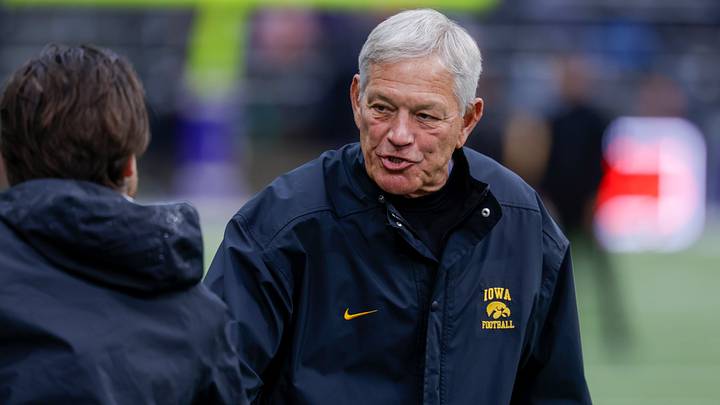
As name, image, and likeness (NIL) deals continue to reshape college sports, Kirk Ferentz keeps doing what he does best: player development.
Since the landmark revenue-sharing decision, college programs have been navigating how to distribute funds. We have seen football programs spend astronomical amounts to bring the most talented players to campus, and in some scenarios, it's worked. Ohio State, Miami, and Notre Dame all have massive payrolls and rank in the top five. Money might drive wins, but Ferentz and the Hawkeyes are proving there are multiple paths to success.
The Iowa football program continues to do more with less
According to On3 Sports, Ohio State, Miami, and Notre Dame have spent over $40 million on their rosters and are projected to be in the mix for a National Championship. While it's worked for them, it hasn't for everyone. LSU's roster is estimated at over $45 million, and they lost their second game last week. Texas A&M dropped to 1-3, and Oregon sits at 3-2 with $40 million rosters. As spending money keeps rising, Iowa is one of the Power Four programs that hasn't spent as much and is still succeeding.
College Football teams winning with small roster payrolls💰
— On3 (@On3) October 13, 2026
(via @PeteNakos) https://t.co/DtRTtwJBWX pic.twitter.com/8s6SwURIOd
The Hawkeyes have one of the smallest payrolls in the Big Ten, but they're 5-1 (2-1 Big Ten) heading into week seven. We hate saying they do more with less, implying the program doesn't have talented players, but the numbers back it up. Iowa has a reported payroll of around $20 million, which is even lower than Northwestern. Kirk Ferentz and the program continue to find undervalued prospects on the recruiting trail and in the transfer portal, and develop them in the system. Iowa currently has two capable quarterbacks, Hank Brown and Jeremy Hecklinski, and despite the offensive inconsistencies, the unit averages 31.0 points per game.
Multiple of Iowa's most talented offensive players have joined the program via the transfer portal, including Hank brown, Jeremy Hecklinski, and Tony Diaz, proving you don't have to pay top dollar for big names. Iowa also continues to develop elite running backs and tight ends, with each group easily going 4-5 players deep. Iowa hasn't bought into the theory that it needs to throw money all over the place to succeed, and has stuck with finding the right players for the system.
Ferentz has always been a bigger proponent of recruiting players and developing them, rather than scouring the transfer portal to fill the roster. It might be an "old-school" way of thinking, but it has worked well for the program, and there's no reason to shift the strategy drastically. Success is relative, and the Iowa program has decided that success means developing players and sending them to the NFL, not having an astronomical payroll to help win a National Championship.
The program's strategy obviously won't change as long as Ferentz is in charge, and even after he retires, it likely won't shift overnight. For now, Iowa will keep doing more with a smaller payroll and focus on a strong second half of the 2026 regular season.
 Add us as a preferred source on Google